Kristian Birkeland (December 13, 1867 – June 15, 1917) was a pioneering Norwegian scientist, best known for his groundbreaking research on the aurora borealis (northern lights) and his theory that they were caused by charged particles from the Sun interacting with Earth’s magnetic field. He conducted extensive experiments, including creating artificial auroras in the laboratory, and led the famous Norwegian aurora expeditions between 1899 and 1903. Birkeland also made significant contributions to electromagnetism, cosmic rays, and polar science, and developed the Birkeland–Eyde process for producing artificial fertilizers, which had major industrial impact. His work laid the foundation for modern space physics, and many of his ideas—initially controversial—were later confirmed by satellite observations.
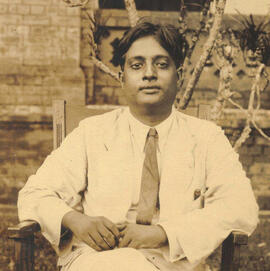
Satyendra Nath Bose (January 1, 1894 – February 4, 1974) was an eminent Indian physicist whose pioneering work in quantum mechanics led to the foundation of Bose–Einstein statistics and the concept of the boson, a class of particles named after him. In 1924, he sent his ground breaking paper on the quantum statistics of photons to Albert Einstein, who recognized its significance, translated it into German, and published it—marking the beginning of the Bose–Einstein collaboration. Bose’s theoretical insights later paved the way for the prediction of the Bose–Einstein condensate, a new state of matter observed decades later. Beyond research, he was a dedicated teacher, serving as professor and later vice-chancellor at the University of Calcutta and the University of Dhaka, and was known for promoting science education in India. His work earned him the Padma Vibhushan in 1954, and he remains one of the most celebrated figures in modern physics.
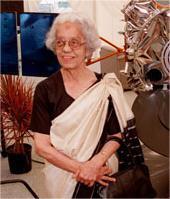
Lalitha Doraiswamy Chandrasekhar (15 October 1910 – 2 September 2013) was an Indian physicist and the wife of Nobel laureate Subrahmanyan Chandrasekhar. She earned her honours degree in physics from Presidency College, Madras, and briefly taught science and mathematics before pursuing research under C. V. Raman. Married in 1936, she moved to the United States with her husband, supporting his academic career at Yerkes Observatory and the University of Chicago. Lalitha was also an accomplished Carnatic musician and flautist, with a deep interest in literature and social causes. Her writings include essays and contributions to volumes of her husband’s selected papers.
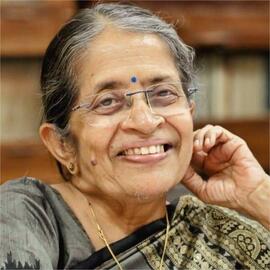
Rohini Godbole is an Indian theoretical physicist known for her work in the field of high-energy physics, particularly in particle physics and astrophysics. She has made notable contributions to the understanding of supersymmetry, string theory, and particle colliders. Her research focuses on topics like the Higgs boson, dark matter, and the search for new particles at high-energy particle colliders, such as those used at the Large Hadron Collider (LHC).