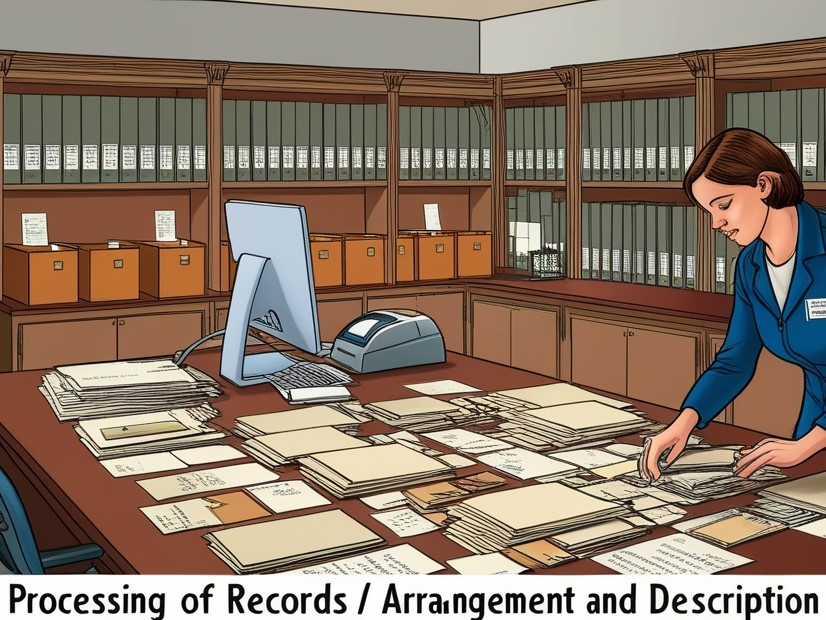

Processing of Records / Arrangement and Description
The IIA Archives maintains a comprehensive accessions register that records all transfers of institutional archival materials. Cataloging plays a pivotal role in the archiving process, involving the creation of metadata and detailed descriptions for the records that are transferred to the Archives. These descriptions, along with associated metadata, enable efficient retrieval of records when needed. The IIA Archives is dedicated to the continuous development and maintenance of a high-quality archival description database, aiming to enhance accessibility for both IIA staff and other users. When organizing records, Archives examine the sequence of documents to identify any recurring themes or patterns. Certain materials might already have a clear hierarchy. In other situations, photos, videocassette tapes, and documents from different years and occasions might be combined. Since these contextual linkages can often provide insight into the workings of an organization, archivists work to maintain the relationships between records that are filed next to one another.In order for scholars to understand the context of the documents, archivists write a description of the fonds. The archivist produces a finding aid, which is a textual depiction of the completed fonds because only some are able to visit the Archives in person. One can view the fonds with the finding aid.Here, the archivist produced a detailed description that covers the contents of every item, the range of dates, copyright, access limitations, physical records quality, and more. Using both published sources and the records themselves, the archivist analyzes the circumstances behind the creation of the records.
To ensure consistency and conformity, the Archives adhere to the ISAD(G) standard (General International Standard Archival Description) to define the elements used in archival finding aids. Initially, descriptions for archival records are created in hard copy format, and data entry sheets are made available for public access in the Exhibition Room. Subsequently, these descriptions are entered into an Online Finding Aid system for broader accessibility.The task of capturing these archival descriptions in data entry sheets, based on ISBD(G) (General International Standard Bibliographic Description), falls under the responsibility of the library staff. It's worth noting that the Archives currently face significant cataloging and retrospective conversion backlogs, and the prioritization of these tasks is determined based on the categories of the collections. This ensures that the most critical and valuable materials receive attention and are accessible to users as efficiently as possible.