
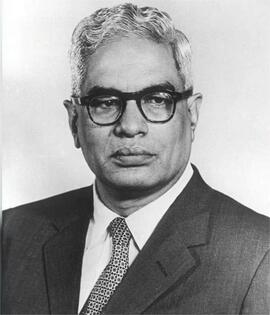
Suri Bhagavantam (1909–1989) was an Indian physicist and scientific administrator known for his work in optics, spectroscopy, and quantum mechanics. He served as Director of the Indian Institute of Science, Bangalore, and later as Scientific Adviser to the Ministry of Defence, playing a key role in advancing India’s defence research. Bhagavantam was also the Director General of the Defence Research and Development Organisation (DRDO) and contributed significantly to building India’s scientific and technological capabilities in the post-independence era.
Bambang Hidayat is an Indonesian scientist known for promoting astronomy nationally and internationally. His work has focused on the study of binary stars and galactic structure. The minor star Hidayat, discovered in 1977, was named after him by Cornelis Johannes van Houten and Ingrid van Houten-Groeneveld. He has over forty papers published to his name and has written several astronomy textbooks.
William Stephen Jacob (1813-1862) was an English immigrant astronomer who served as the director of the Madras Observatory in India from 1848 to 1859. During his tenure at the Madras Observatory, Jacob conducted various astronomical observations and experiments. He compiled a catalog of 244 double stars observed at Pune with a 5-foot equatorial. He also made observations of the Saturnian and Jovian systems and computed orbits for several binary star systems. He participated in the official expedition to Spain to observe a solar eclipse in 1860. He made accurate measurements of saturns rings and satellites of Jupiter. He was elected a fellow of the Royal Astronomical Society in 1849. Unfortunately, his life was short, and he died in Pune in August 1862 at the age of 48.
Arun Mangalam is a Senior Professor at the Indian Institute of Astrophysics, Bangalore. Arun does research in theoretical astrophysics: gravitational dynamics, relativistic astrophysics, gas dynamics and magnetic fields. His interests include relativistic, high energy, stellar dynamical and hydromagnetic processes concerning black hole systems, galaxies, cosmology and solar plasma. He also teaches undergraduate and graduate physics and astrophysics courses.
John Alexander Reina Newlands (26 November 1837 – 29 July 1898) was a British chemist who worked concerning the periodicity of elements.
Theodor Ritter von Oppolzer was an Austrian astronomer and mathematician. Oppolzer was known for his remarkable memory and was reputed to have memorized the values of 14,000 logarithms. He authored over 300 papers, primarily focusing on the determination of the orbital elements of comets and asteroids. Additionally, he conducted an expedition to observe a solar eclipse in 1868.
Sir Chandrasekhara Venkata "C. V." Raman (7 November 1888 – 21 November 1970) was an Indian physicist, known for his work in the field of light scattering.[4] Using a spectrograph that he developed, he and his student K. S. Krishnan discovered that when light traverses a transparent material, the deflected light changes its wavelength. This phenomenon, a hitherto unknown type of scattering of light, which they called modified scattering was subsequently termed the Raman effect or Raman scattering. In 1930, Raman received the Nobel Prize in Physics for this discovery and was the first Asian and non-White to receive a Nobel Prize in any branch of science.
J. Hanumath Sastri is a scientist affiliated with the Indian Institute of Astrophysics (IIA) in Koramangala, Bangalore. He is also a member of the International Astronomical Union (IAU). His research interests include the equatorial ionosphere-thermosphere system, particularly during geomagnetic storms, and the dynamics of the ionosphere and thermosphere
Mary Somerville (26 December 1780 – 29 November 1872) was a Scottish scientist, writer, and polymath. She studied mathematics and astronomy, and in 1835 she and Caroline Herschel were elected as the first female Honorary Members of the Royal Astronomical Society.
Sitaram Rao Valluri (June 25, 1924 – January 23, 2019) was an engineer and scientist noted for his work in metal fatigue. He completed his doctorate in 1954 at Caltech with a dissertation under Ernest Secheler and stayed thereafter to continue his research work.