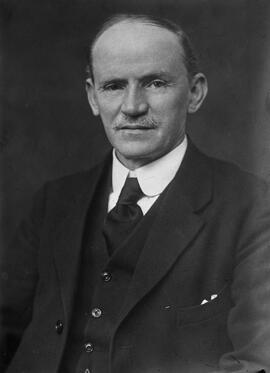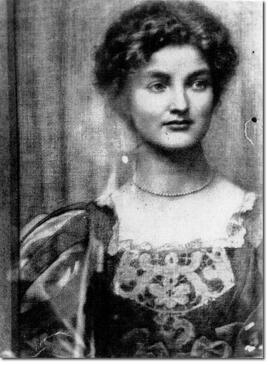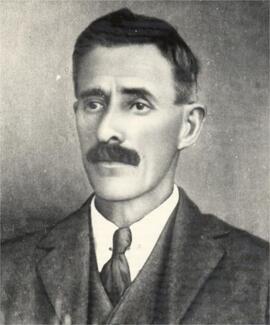
Kavasji Naegamvala, also known as Kavasji Dadabhai Naegamvala (1857-1938) (FRAS) was an astrophysicist and the director of the Takhtasingji Observatory. Naegamvala's work included observations of nebulae, solar flash spectrum, and the transit of Mercury on 9 May 1891. He joined the British Astronomical Association expedition to Norway, in 1896, to observe a total solar eclipse. His independently organized, and conducted, expedition to Jeur, in western India, to observe the solar chromosphere and corona, during the 1898 eclipse, broke a psychological barrier to the entry of Indian scientists to the study of astronomy.
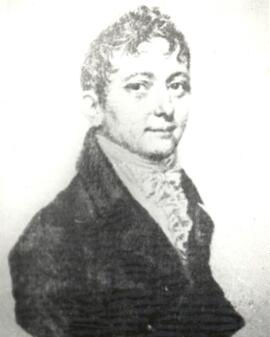
Elias Loomis (1811-1889) was an American mathematician and astronomer. He was a mathematics and natural philosophy professor at Western Reserve College (now known as Case Western Reserve University) in Ohio. Loomis significantly contributed to astronomy, particularly in the United States, during the 19th century.
Sir Harold Spencer Jones (1890-1960) was an English astronomer who served as the 10th Astronomer Royal of England from 1933 to 1955.
Harlan James Smith (August 25, 1924 – October 17, 1991) was an American astronomer. He served as director of the University of Texas McDonald Observatory from 1963 to 1989, where, among other accomplishments, he initiated the construction of the Harlan J. Smith Telescope, a 2.7-meter (107-inch) reflector bearing his name.
Sir William Huggins (7 February 1824 – 12 May 1910) was a British astronomer best known for his pioneering work in astronomical spectroscopy together with his wife, Margaret
John Goldingham was a notable figure in astronomy and engineering, serving as the first official astronomer of the Madras Observatory and later becoming the Presidency Civil Engineer in 1800. During his tenure, Goldingham established the Madras time, 5 hours and 21 minutes ahead of GMT, laying the closest precedent to the later Indian Standard Time adopted in 1906. His work was influential in astronomy, contributing to the publication of the 'Madras Catalogue' that documented the positions of 11,000 stars.
Leo (Leopold) Goldberg (26 January 1913 – 1 November 1987) was an American astronomer renowned for his work in solar physics, stellar spectroscopy, and atomic physics, as well as for his leadership of major observatories. Educated at Harvard under Donald H. Menzel, he introduced key concepts such as microturbulence in stellar spectra and advanced early space-based solar observations. Goldberg served as Director of the University of Michigan’s Astronomy Department (1946–1960), Harvard College Observatory (1966–1971), and Kitt Peak National Observatory (1971–1977), and was President of both the American Astronomical Society and the International Astronomical Union. A skilled scientific diplomat during the Cold War, he received numerous honors, including NASA’s Distinguished Service Medal, and left a lasting legacy in observational and institutional astronomy.
Alfred Fowler (22 March 1868 – 24 June 1940) was a British astronomer and astrophysicist renowned for his pioneering work in astronomical spectroscopy. He served as Professor of Astrophysics at Imperial College London and was an authority on the spectra of stars, the Sun, and nebulae. He was active in the International Astronomical Union and served as its first General Secretary (1919–1922). In recognition of his contributions, he was awarded the Gold Medal of the Royal Astronomical Society in 1918.
Mary Evershed (1 January 1867 – 25 October 1949) was a British astronomer and scholar of Dante Alighieri’s works. She is noted for her research in solar astronomy and her collaboration with her husband, John Evershed, at the Kodaikanal Solar Observatory in India.
John Evershed (1864-1956) was an English astronomer who, in 1909, discovered the horizontal motion of gases outward from the centres of sunspots, a phenomenon sometimes called the Evershed effect. In 1906, Evershed became assistant director of the Kodaikanal and Madras observatories in India, later becoming director. Evershed retired in 1923, returning to England; in 1925, he built his own solar observatory at Ewhurst.