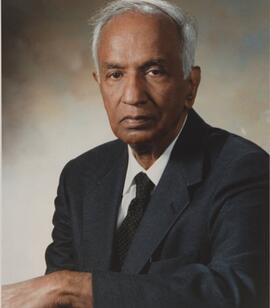

Subrahmanyan Chandrasekhar FRS (1910 – 1995) was an Indian-American theoretical physicist who spent his professional life in the United States. He shared the 1983 Nobel Prize for Physics with William A. Fowler for "...theoretical studies of the physical processes of importance to the structure and evolution of the stars". His mathematical treatment of stellar evolution yielded many of the current theoretical models of the later evolutionary stages of massive stars and black holes. He was on the faculty at Chicago from 1937 until his death in 1995 at the age of 84, and was the Morton D. Hull Distinguished Service Professor of Theoretical Astrophysics.
Maroli Krishnayya Chandrashekaran (1937 – 2009), also known as Shekar or MKC, was an Indian zoologist, regarded as the founder of Indian chronobiology, the study of biological rhythms of organisms. He was a fellow of the Indian Academy of Sciences, and the Third World Academy of Sciences, and in 1979 received the Shanti Swarup Bhatnagar Prize for Science and Technology.He served as editor of the Journal of Biosciences from 1991 to 1997 and Resonance: Journal of Science Education from 2003 to 2005.
Maroli Krishnayya Chandrashekaran is an eminent Indian chronobiologist, widely regarded as one of the pioneers in the study of biological rhythms in India. He made significant contributions to understanding circadian rhythms in animals, particularly in insects and crabs, and explored how environmental cues like light and tides influence their internal clocks. Chandrashekaran served as a professor and later as chairman of the Centre for Advanced Studies in Zoology at the University of Madras.